Sunday, 10 March 2013

Vibration

What is vibration:

Vibration is a  periodic back-and-forth motion of the particles of an elastic body or medium, commonly resulting when almost any physical system is displaced from its equilibrium condition and allowed to respond to the forces that tend to restore equilibrium.

Real Life examples of vibration:

1. Using a guitar as a musical instrument. The string goes back and forth which makes the sound and also the vibration.

2. Listening to a music through a speaker. The speaker makes sound vibration which makes the sound quality better.

Pendulum and spring:


Examples of real life:


Sunday, 24 February 2013

Conservation of Energy


Mechanical Energy

In sciencemechanical energy is the sum of potential energy and kinetic energy. It is the energy associated with the motion and position of an object. The law of conservation of mechanical energy states that in an isolated system that is only subject to conservative forces the mechanical energy is constant.


Types of Mechanical Energy:

Potential and Kinetic energy


Potential Energy


In physicspotential energy is the energy of an object or a system due to the position of the body or the arrangement of the particles of the system. The SI unit for measuring work and energy is the joule (symbol J).


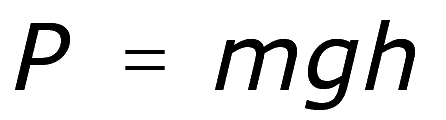
Formula of Potential energy


Examples


Case 1: A cat had climbed at the top of the tree. The Tree is 20 meters high and the cat weighs 6kg. How much potential energy does the cat have?

 m = 6 kg, h = 20 m, g = 9.8 m/s2(Gravitational Acceleration of the earth)
  Step 1: Substitute the values in the below potential energy formula:
            Potential Energy: PE = m x g x h
            = 6 x 9.8 x 20
            Potential Energy: PE = 1176 Joules 


Kinetic Energy


In physics, the kinetic energy of an object is the energy which it possesses due to its motion. It is defined as the work needed to accelerate a body of a given mass from rest to its stated velocity.


Formula of Kinetic energy


Examples


Case 1: Determine the Kinetic energy of a 500kg roller coaster train which moves at a speed of 20 m/s.

 M = 500 kg, V = 20 m/s
  Step 1: Substitute the values in the below kinectic energy formula:
            Kinetic Energy: Ek = ½ mv2
            = ½ x 500 x 202
            = 0.5 x 500 x 400
            Kinetic Energy: Ek = 100000 Joules or 1 x 10⁵ Joules


What is conservation of energy

The law of conservation of energy, first formulated in the nineteenth century, is a law of physics. It states that the total amount of energy in isolated system remains constant over time. The total energy is said to be conserved over time. For an isolated system, this law means that energy can change its location within the system, and that it can change form within the system, for instance chemical energy can become kinetic energy, but that energy can be neither created nor destroyed.

Examples of conservation of energy

To scientists, conservation of energy is not saving energy. The law of conservation of energy says that energy is neither created nor destroyed. When we use energy, it doesn’t disappear. We change it from one form of energy into another. A car engine burns gasoline, converting the chemical energy in gasoline into mechanical energy. Solar cells change radiant energy into electrical energy. Energy changes form, but the total amount of energy in the universe stays the same. Scientists at the Department of Energy think they have discovered a mysterious new form of energy called "dark energy" that is actually causing the universe to grow! 

Sunday, 17 February 2013

Self Assessment 15.6


1. Fossil fuels are considered as a source of energy which is not renewable. Why is it so?

Because it takes long time to reproduce.

2. What happens if the fuel consumption is not spared?

World will have a trouble running factories and producing stuff.

3. According to your opinion, in order to produce electrical energy, what is the best energy that fits with the current situation and is pollution free?

I think its waterfall energy. Since the waterfall energy gives us sufficient amount of energy and its unstoppable. It is also a pollution free technology.

4. Write your suggestions in order to produce a very high temperature, so that a large amont of electricity can be generated from the use of seawater.

In order to produce a very high temperature that is generated from seawater, the tidal energy will do so. Tidal energy will produce energy which can be reversed into a very high temperature.

Monday, 4 February 2013

Sources of energy


Renewable and Non-Renewable energy
       Source of energy which is renewable is the source of energy which can be regenerated when it is used up.
       Source of energy which is not renewable is the source of energy which cannot be regenerated again.


Renewable Energy
       Nowadays, renewable energy is frequently used as an alternative energy to replace conventional energy and fossil fuels. The sources of alternative energy are, for example, wind energy, waterfall energy, solar energy, nuclear energy, tidal energy, geothermal energy, and biomass energy


Wind energy
       Wind is one of many renewable sources of energy, because it is always available.
       Since hundred years ago, windmills have been used to grind and to pump water.
       Nowadays, windmills are used to drive electric generators to produce electricity.


Waterfall energy
       Waterfall is a good resource of energy since is always moves the turbine. Moving water has sufficient potential and kinetic energy.


       Advatages are efficient in receiving electrical energy, can be used for irrigation and as an object of tourism, and electrical energy becomes cheap


Solar energy
       Easy to get
       Pollution free
       2 methods to collect the energy
        Passive method has been used since many centuries ago. Example now is glass windows.
        Active method is to use solar panels to collect the sunray. It transforms solar energy to thermal energy and becomes electrical energy.


8.
Nuclear Energy
       The nuclear energy is from the energy release generation by the splitting of the atomic nucleus. The reaction is called fission. This fission produces a huge amount of energy which is called nuclear energy. Nowadays, nuclear energy is used for electric power plant, and usually called a nuclear power plant.
       Operation of a nuclear power plant is based on fission. Fission is the process of a heavy nucleus into two lighter nuclei accompanied by a huge energy release.
       Fusion  is the process of joining the nuclei of atoms accompanied by a huge energy release.


Tidal Energy
       The tidal of river water can be used to generate electricity; the power plant is called a tidal power plant. But it has high construction cost!!!\


Geothermal Energy
       It uses a hot geyser or steam
       A power plant which uses geothermal is called a geothermal power plant. There are many in Indonesia.
        Since it needs a hot geyser, the disadvantages are limited areas which conform to the requirement for the operation and high cost.


Biomass energy


   •       Energy coming from plants or animals. To get biomass energy, plants are processed into alcohol. Then, similar to gasoline, the alcohol can be used as a fuel for engine combustion. Plants that can be processed to get the alcohol are sugar cane, cassava, wheat, and seaweed.


Non-renewable Energy


       Source of energy which is not renewable is the source of energy which cannot be regenerated again. Examples are fossil fuel, trees, water, land

Sunday, 27 January 2013

Practicing Physics (Work)

Classjump.com/s/sidiq
http://www.classjump.com/s/sidiq/documents/Worksheet31Work.pdf?
------------------------------------------------------------------------------------------------------------------
Classjump worksheet 
Doing the even numbers
Process of solving / Examples


2. A tugboat pulls a ship with a constant force of 5000 N, causing the ship to move through a harbor. How much work does the tugboat do on the ship if each moves a distance of 3 km?

W=5000Nx3000m
=15000000 Joules
=15Mega Joules


4. A husky dog does 20 kJ of work as he pulls a sleigh with a force of 340 N. Through what distance does he pull it?
W/F=S
20000J/340N = S
                       = 58.8m


6. What is the weight of a mass of 100 kg? Find the work done in raising a mass of 100 kg through a vertical height of 60 m.

1000N x 60m = 60000Joules
                       = 60KJ

8. Carlos does a chin-up in gym class and raises himself 0.8 m.  If Carlos has a mass of 62 kg, how much work does he accomplish? 

W= 620Nx0.8 =490 Joules


10. A girl pushes her little brother on his sled with a force of 300 N for 750. m.  How much
work is this if the force of friction acting on the sled is
(a) 200 N?
(b) 300 N?

(a) W= (300-200) x 750 = 75000 Joules
(b) W= (300-300) x 750 = 0 Joules


Monday, 21 January 2013

Energy


Science for Junior High School
2nd Semester Grade VIII
----------------------------------------------------------------------------------------------------------------------------------
Science Text Book Page 52-57
What is Energy
What are the forms of energy in terms of physics

A. What is Energy

                Energy is a "power" that makes the work occur. Which means it is the capacity of a physical system to work. It has many types of energies, those are chemical energy, thermal energy, sound energy, light energy, electrical energy, nuclear energy, and the most important mechanical energy. Since work and energy have a relation, energy is also Joules (J) like work. 

B. Forms of Energy
DEFINITION
EXAMPLES
                  As is explained above, there are many types of energy. Those are chemical energy, thermal energy, sound energy, light energy, electrical energy, nuclear energy, and mechanical energy. In this section B, I will going to explain each types of the energy, and also the definition of it.

1. Chemical Energy: Chemical energy is the energy mostly contained in your body. You can also find chemical energy in food, and some natural resources such as coal, oil, and natural gas. Joules (energy) that are produced by food is kept in the human body in order to perform activities. Most dominant energy resource of food is carbohydrates (rice, bread, grains) and also fat (Milk, butter, oil).


2. Thermal energy: Thermal energy is the energy related with the really small motion of particles producing a heat. You can find thermal energy by rubbing hands together, and also from everywhere that produces heat. Such as, a geyser. 


3. Sound energy: Sound energy is the energy produced through the vibration of air particles around a sound source.  Think of a car horn for an example. It produces vibration on air particles because of a strong sound


4. Light energy: Light energy is the energy produced by the radiation of electromagnetic waves. For an example, Earth gets brighten up because of the sun illuminating the darkness of the space near an Earth.


5. Electrical energy: Electrical energy is the energy produced by electrical charges which move through the cables. For example, a laptop is being charged by the charger which uses the electrical energy. 


6. Nuclear energy: Nuclear energy is the energy released from the reaction of the nucleus of radioactive matters. There are two kinds of nuclear energy; they are a fusion energy ( the join of the nucleus of an atom) and a fission energy (the split of the nucleus of an atom). Power plant is a great example of nuclear energy.The most visible source of nuclear energy are the more than 400 worldwide power plants that function on nuclear reactors. These reactors contain the reaction of nuclear fission, which produces heat that is then used to create electricity. More than 20 percent of power in the United States is produced by these power plants.


7. Mechanical energy: Mechanical energy is the energy associated with motion. Which means is an energy of an object due to its motion or position. Mechanical energy can be either kinetic energy (energy of motion) or potential energy (stored energy of position). A moving car possesses mechanical energy due to its motion (kinetic energy).A moving baseball possesses mechanical energy due to both its high speed (kinetic energy) and its vertical position above the ground (gravitational potential energy). A World Civilization book at rest on the top shelf of a locker possesses mechanical energy due to its vertical position above the ground (gravitational potential energy). A barbell lifted high above a weightlifter's head possesses mechanical energy due to its vertical position above the ground (gravitational potential energy). A drawn bow possesses mechanical energy due to its stretched position (elastic potential energy).